
It is tempting to read that as a challenge. It is more likely an invitation. They may have found a useful idea. They may also want to know that you have looked at their options thoroughly and are using capable tools on their behalf. You won’t know which until you ask.
Either way, the best response is the same: take the idea seriously and make it personal.
This is now normal, and it is good news
Clients asking AI about money is no longer unusual. About a third of the 6,686 investors Vanguard surveyed in June 2026 had used AI for some form of financial guidance.
of financial professionals say clients use AI to check the advice they are given.
Pacific Life survey of 113 financial professionals, September 2026
as likely to say AI raised the value of human advice as to say it lowered it.
That can sound like a threat. The research points the other way. In the same Vanguard survey, 41% of advised clients said they value their human advisor more after using AI. The client who sends you the chatbot’s answer is not replacing you. They are asking you to weigh in.
Start by asking what prompted the question
A Social Security question is rarely only about Social Security. It may be about a friend who just retired, a headline about the trust fund, or a worry about running out of money. Ask before you answer. Then:
“I'm glad you sent this. Let's look at how it could work for you, what the tradeoffs would be, and whether it improves your plan.”
There is a reason they asked the chatbot first. In a 2026 SoFi survey, nearly half of the people who use AI for investing questions said they do so because they feel uncomfortable asking others. A client who forwards the answer to you has moved past that discomfort. Reward it.
The chatbot’s answer was sound. It just wasn’t about them.
“Wait until 70” is good general advice. Each year of delay past full retirement age raises the benefit, and a bigger check for life is valuable insurance against a long retirement. A chatbot that says so is not wrong.
What it usually lacks is the household. For a claiming decision, the household is most of the answer:
- Who earned what. A spousal benefit stops growing at full retirement age. Waiting longer adds nothing to it.
- Who is likely to outlive whom. The larger benefit continues for the survivor, so delaying the higher earner’s claim protects both spouses.
- What pays the bills in the meantime. Delay is funded by portfolio withdrawals, which affects taxes and how much stays invested.
- Health and family history. Delay pays off with a long life. Not every client expects one.
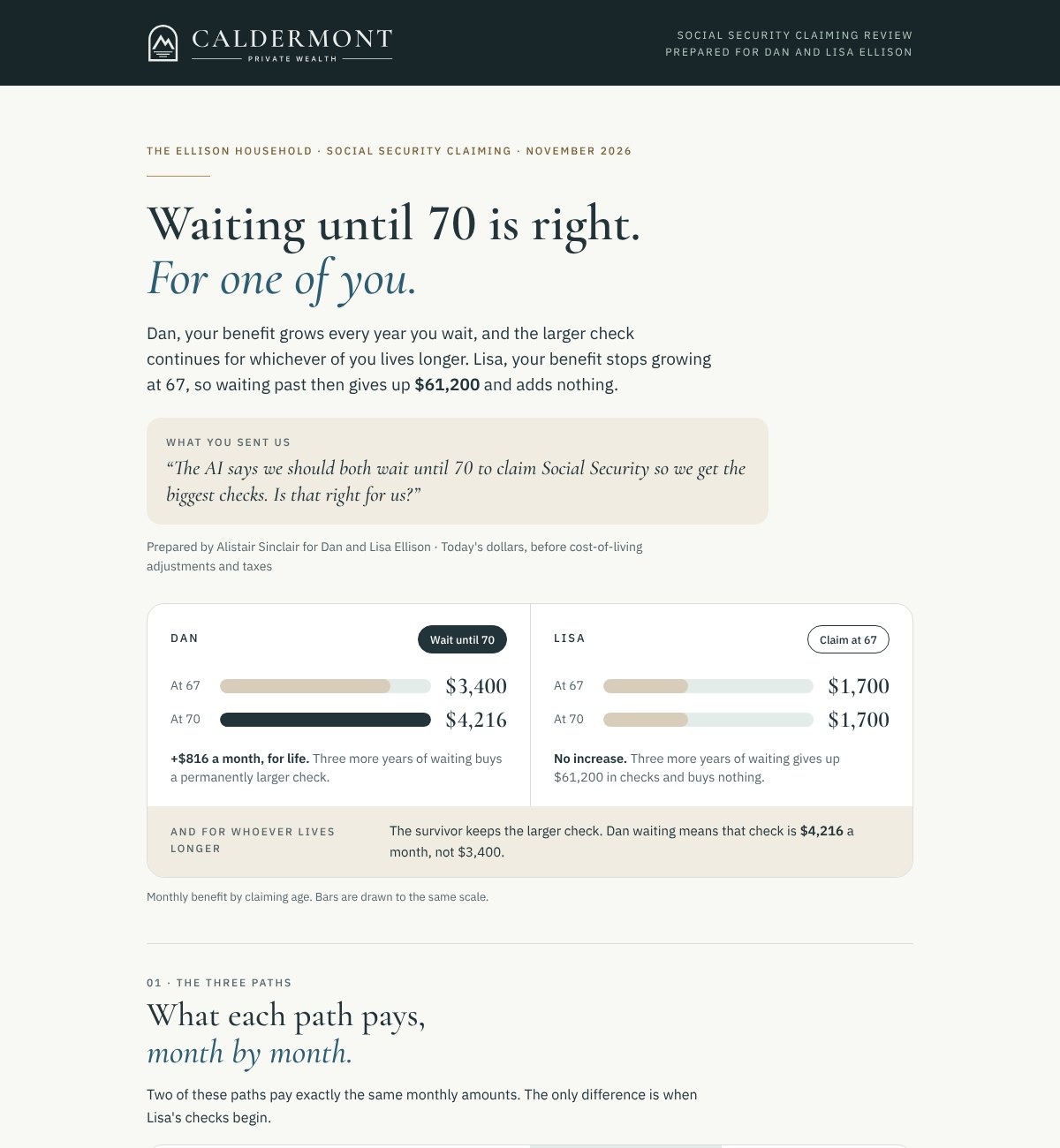
Take Dan and Lisa, a hypothetical couple. Dan is 66 and Lisa is 63, and both reach full retirement age at 67. Dan’s benefit at 67 is $3,400 a month. Lisa’s own benefit is $1,100, so a spousal benefit brings her to $1,700. The chatbot told them both to wait until 70.
For Dan, waiting adds $816 a month for life, and that larger check continues for whichever of them lives longer. For Lisa, three more years of waiting would give up about $61,200 in checks and buy nothing. The chatbot was right about one of them.
Answer with a report built around their question
A verbal “it depends” does not give a client much confidence. A short report built around their household does. It needs four parts:
- What the idea could accomplish. State its benefit fairly, in their numbers.
- How it compares with today’s plan. Put the paths side by side.
- Which assumptions drive the outcome. Show what would change the answer.
- What you recommend. Include anything you still need from them.
Here is what that looks like for Dan and Lisa.
Building a report like this
In Helmsted, the request for a report like this is one sentence:
“Lisa sent this from her AI. Make an Interactive visual showing whether waiting until 70 is right for them, and what I'd recommend instead.”
Helmsted already holds the household’s ages, benefits and accounts, so the advisor does not restate them. The same analysis can just as easily arrive as a PDF, a Word document or a spreadsheet, depending on how that client best takes in information.
The technology does the comparison. The advisor makes the call.
The takeaway
A client who brings you an AI recommendation may be looking for confidence that their options have been considered carefully. Telling them the chatbot was wrong does not provide it. Showing them their own options, evaluated by someone who knows them, does.
Sources: Vanguard, The AI advice frontier (2026); Pacific Life survey, reported by NAPA (2026); SoFi AI investing survey (2026); Social Security Administration on spouse's benefits.